
Restoring patients’ voices during critical care through innovative tracheostomy technology
Executive summary
For patients recovering from critical illness, having a tracheostomy can be lifesaving. It’s a procedure where a hole is made at the front of the neck and a tube is inserted through the opening into the windpipe. The tracheostomy tube can be connected to a ventilator to help somebody breathe. Tracheostomies are often used in Intensive Care Units (ICU) for patients who need breathing support. Around 20,000 new tracheostomies are inserted in the UK each year.
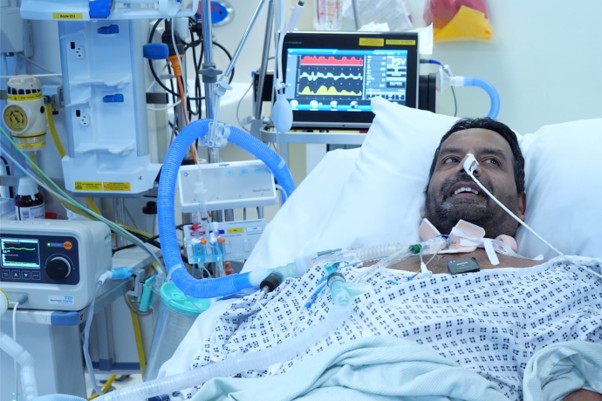
Although a lifesaving procedure, many patients are temporarily unable to speak because the tracheostomy tube redirects airflow away from the vocal cords. Patients in this situation try to communicate at first through writing, gestures or lip reading, but this can be difficult due to the effects of critical illness. Limited communication increases anxiety, makes it difficult to express basic needs, and slows rehabilitation.
Researchers at Manchester University NHS Foundation Trust (MFT) developed and tested an innovative device that enables patients with a tracheostomy to speak much earlier in their treatment pathway, while still receiving ventilation.
The team collaborated with Designing Science, Manchester Metropolitan University (MMU), the National Tracheostomy Safety Project charity, patients and staff. The NIHR HealthTech Research Centre: Emergency and Acute Care (HRC EAC) played a key role in supporting the project’s health economic evaluation, commercial engagement and future study design, helping move the technology closer to NHS adoption.
Early clinical evaluation demonstrated that the device restored speech in all study participants while also improving swallowing and coughing, supporting faster recovery and enhancing patients’ quality of life. With further evaluation and commercial development, the technology has the potential to transform care for thousands of critically ill patients across the NHS.
Clear purpose
Between 10-15% of all patients recovering from critical illness require a temporary tracheostomy to support breathing while they recover in intensive care.
Although essential, conventional tracheostomy tubes prevent airflow through the vocal cords as the “cuff” on the end of the tube is initially inflated to maximise the delivery of gas to the lungs. This means many patients are unable to speak for days or even weeks. The inability to communicate can be distressing for patients and families, contributing to feelings of fear, anxiety and isolation at an already vulnerable time.
Communication difficulties can also affect clinical care, making it harder for healthcare professionals to understand patients’ needs, symptoms and concerns. But a lack of normal airflow creates other problems beyond speaking. Swallowing difficulties delay eating and drinking, create issues for secretion management, prolong rehabilitation and increase the risk of complications.
This project set out to address these challenges by developing a simple innovation called Safe and Effective Above Cuff Tracheostomy Vocalisation (SEA CTV), that restores speech and laryngeal airflow safely while patients remain ventilated via a cuff-inflated tracheostomy.
SEA CTV works with the ICU ventilator to deliver a carefully controlled additional air flow through the vocal cords and larynx (voice box) during exhalation, replicating normal talking. This restores speech while also helping to stimulate swallowing and coughing. Airflow is continuously monitored by sensors and automatically stops if any problems are detected, helping to keep patients safe and reduce the risk of complications.
The NIHR HRC: EAC accelerated this innovation beyond initial development by providing health economic expertise, supporting commercial engagement and helping design the next phase of clinical evaluation needed for wider NHS adoption. Without this support, promising early findings would have been more difficult to translate into a technology capable of benefiting patients at scale.
Approach
The project was supported through the NIHR Invention for Innovation (i4i) funding (NIHR200023), which enabled the development and clinical evaluation of a prototype device that allows airflow above the tracheostomy cuff, restoring speech while maintaining safe independent ventilation of the lungs.
The engineering development of SEA CTV was led by Dr Rasool Erfani at MMU. This involved the design and integration of the device components, development of the sensor configuration, and assembly of the prototypes. Computational airflow modelling and engineering evaluations were also carried out by the engineering team to provide further insight and support the safe and effective development of the technology.
Alongside the technical and clinical development, the NIHR HRC: EAC helped ensure the project considered implementation, commercialisation and long-term sustainability from an early stage. The team were able to create compelling patient stories, animations and explainer videos that communicated the clinical problem, the functions of the device, and some real-world examples of the device in use. You can see these HRC-enabled videos on the NTSP’s website.
Restoring the ability to speak has a profound impact on patients’ recovery and experience. Alongside its benefits for patients, the technology must demonstrate value for the NHS. The HRC modelled the potential impact of earlier recovery on ICU bed use and costs, helping to build a robust case for further research and future adoption.
Findings
SEA CTV allowed patients to start speaking much earlier in their recovery, which led to significant reductions in anxiety and significant improvements in swallowing function.
Every patient using SEACTV was able to speak, with around 90% of participants able to speak on first use of the device (day 0). Free text responses were captured from patients and staff. One patient described “loving hearing the sound of my voice,” while another was able to “raise my voice and communicate effectively.” By comparison, less than half of the standard care group were able to speak by day 1, with around 20% still unable to vocalise by day 7.
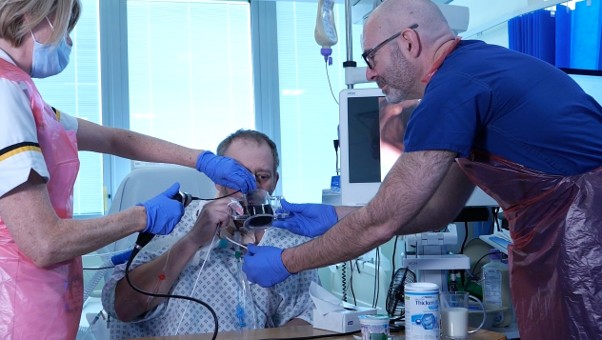
Staff found the SEACTV a useful addition to recovery, with one ICU nurse reporting that her patient was, “[already] communicating well with lip reading but the SEACTV was really good.” Improvements were also seen in coughing and swallowing with SEACTV. Better swallowing function enabled patients to return to eating and drinking sooner, supporting earlier rehabilitation and recovery.
Early findings suggest that improved recovery may contribute to shorter intensive care stays, saving around £3,500 in ICU bed days per patient, per day, while freeing up beds for other patients and delivering important benefits for both patients and healthcare services.
Professor Brendan McGrath, NIHR HRC: EAC Theme Lead and Intensive Care Consultant at Wythenshawe Hospital, part of MFT, who led this project, said: “The SEA CTV project was great to work on and was made possible by the NIHR funding and infrastructure that we have in Manchester, including the NIHR HRC: EAC.
“It was great to see the immediate benefit of patients talking much earlier in recovery with SEA CTV, instead of relying on lip reading, gestures or writing to communicate which is a challenge for everyone. Alongside restoring speech, we saw some immediate improvements to swallowing and laryngeal recovery too, which makes us really excited about the next steps in developing this technology, to improve recovery for critically ill patients.”
Insights and impact
The technology has the potential to deliver significant benefits across patients, healthcare professionals and the wider NHS.
For patients, restoring the ability to communicate represents much more than simply speaking. It allows people to express pain, ask questions, participate in decisions about their care and reconnect with family members during one of the most difficult periods of their lives. Improved swallowing may also enable patients to return to eating and drinking sooner, while potentially reducing complications associated with prolonged ventilation.
For healthcare professionals, better communication improves patient-centred care by allowing clinical teams to understand patients’ needs more quickly and respond more effectively.
The HRC’s support has been instrumental in moving the innovation beyond proof of concept. By generating evidence on clinical and economic value and facilitating engagement with commercial partners, the NIHR HRC: EAC is helping establish a credible pathway towards manufacturing, regulatory approval and future NHS adoption.
The project aligns closely with NHS priorities to improve patient outcomes, increase healthcare efficiency and accelerate the adoption of innovative technologies that enhance recovery and deliver better value for patients and the health service.
Reflections
This project demonstrates the importance of supporting innovation beyond clinical research alone.
From the earliest discussions with the NIHR Research Design Service (now known as the Research Support Service) through to delivery of the study and ongoing support from the NIHR HRC: EAC, the project has benefited from sustained collaboration across the innovation pathway.
The research team highlighted the flexibility shown by NIHR during the COVID-19 pandemic, when many clinical staff were redeployed to frontline intensive care services. The NIHR were able to fund the inevitable extension to the study as part of the pandemic recovery program. Maintaining open dialogue throughout the project enabled challenges to be addressed collaboratively while ensuring progress could continue when circumstances allowed.
The experience also reinforces the value of engaging commercial partners early, alongside health economists and implementation specialists, to maximise the chances of successful adoption once clinical evidence has been established.
Next steps
The next stage of the project will focus on identifying a commercial partner to licence, manufacture and market the device following CE and UKCA marking.
A larger multicentre clinical trial will also be undertaken to generate further evidence on safety, effectiveness and cost-effectiveness, supporting future regulatory approval and NHS implementation.
The NIHR HRC: EAC will continue supporting this next phase by helping develop the evidence required to bring this innovation closer to routine clinical practice.
Images and resources
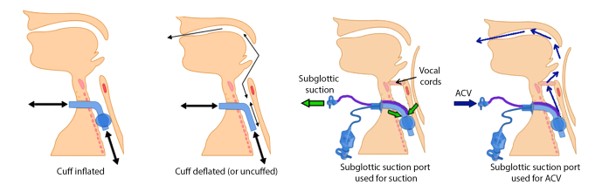
Different ways air can flow when a tracheostomy is used to deliver invasive ventilation to the lungs. In the early stages of recovery, the cuff is inflated (left image) and air cannot flow out via the voice box (larynx). Cuff deflation occurs later in the recovery. SEA CTV provides an additional flow of gas via a standard tube that exits above the cuff (right image) delivering Above Cuff Vocalisation (ACV) when talking would otherwise not be possible.
For further information, please visit:
- National Tracheostomy Safety Project website: tracheostomy.org.uk
- SEA CTV in action https://tracheostomy.org.uk/healthcare-staff/vocalisation/sea-ctv
- Laryngeal rehabilitation video: https://tracheostomy.org.uk/healthcare-staff/vocalisation/sea-ctv-and-laryngeal-rehab