
Inside HealthTech Research: Careers in HealthTech Blog Series – Dr Kim Kirby
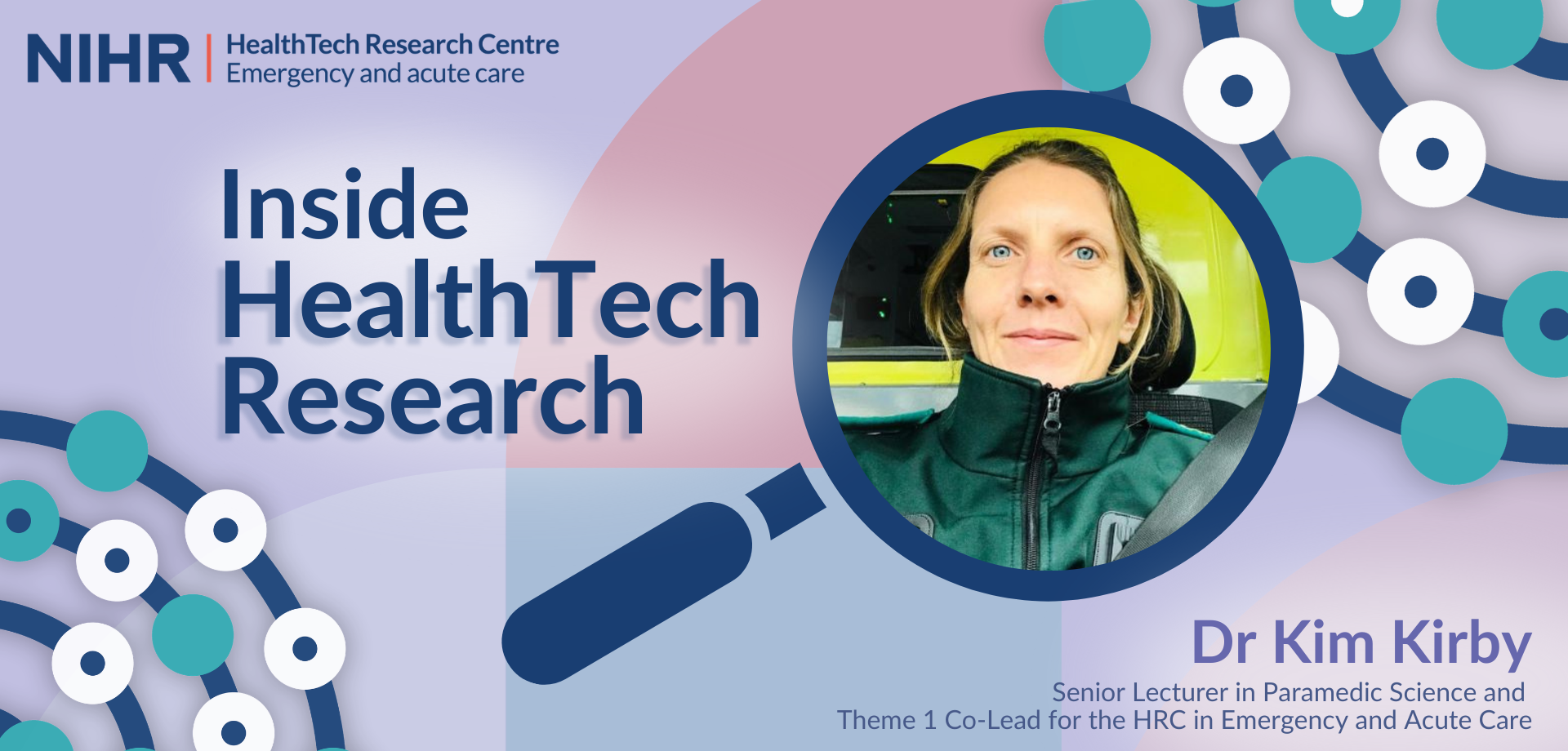
Welcome to our Inside HealthTech Research: Careers in HealthTech blog series where we spotlight pioneering researchers from the National Institute for Health and Care Research (NIHR) HealthTech Research Centre in Emergency and Acute Care (HRC).
Each blog explores their personal innovation journeys, the ways they have developed impactful research in partnership with industry, and the lessons they have learnt along the way.
In this latest edition, Dr Kim Kirby reflects on how collaborating with industry has opened up new opportunities for codeveloping health technologies and driving innovation. She highlights the importance of openness and transparency when working with commercial partners and shares her own path through the NIHR Clinical Academic training route as a paramedic.
I am a Senior Research Fellow/Senior Lecturer in Paramedic Science at the University of the West of England and co-lead Theme 1 at the NIHR HealthTech Research Centre in Emergency and Acute Care, alongside Professor Rick Body. My career spans over 20 years as a practicing paramedic, and I continue to work part-time in the 999-triage centre, supporting remote patient triage. This frontline experience has shaped my research interests, particularly in chest pain and the recognition of patients at imminent risk of cardiac arrest.
For the past ten years, I have pursued pre-hospital research through the NIHR Clinical Academic training route. I completed an NIHR-funded PhD (NIHR Clinical Doctoral Research Fellowship) investigating the recognition and triage of patients at risk of out-of-hospital cardiac arrest. This work led to my current interest in the triage of patients suffering with chest pain who call for an ambulance and also point-of-care troponin testing – a blood test paramedics can perform at the scene to determine whether a patient is having a heart attack.
Alongside my academic role, I work with the Dorset and Somerset Air Ambulance Charity as the Lead Research Paramedic to support with developing research activities. I provide advice and support and this might include supporting research with new technology and collaborating with HealthTech companies.
How did you start working with industry?
I first engaged with industry partners after working with Professor Rick Body and acting as a Principal Investigator in the PRESTO study for the South Western Ambulance Service NHS Foundation Trust (SWASFT).
PRESTO explored whether paramedics could accurately use a simple algorithm and a near-patient blood test to avoid unnecessarily transporting patients with suspected acute coronary syndromes to hospital.
Working with Rick on PRESTO introduced me to the opportunities of working in partnership with industry. Previously, I had preconceived ideas about working with companies and worried it might conflict with my role as a clinical academic. Rick demonstrated that, when managed transparently, industry partnerships can strengthen research rather than compromise it.
My first industry collaboration was with Corti AI, exploring a technology for triaging chest pain patients. Since then, I’ve been involved in large grants investigating point of care troponin testing in ambulances, which has required many constructive conversations with companies and has reinforced the value of early clinical input.
Collaborating with industry during my fellowship
In 2024, I was awarded the NIHR Development and Skills Enhancement Award (DSE), which focused on entrepreneurship and working with industry. Following this award, I was invited to apply for a Zinc Innovation Fellowship, a partnership between the NIHR and The Dunhill Medical Trust. This fellowship placed me directly inside HealthTech companies and gave hands on experience of research in a very different context to my usual clinical academic perspective.
As part of the Zinc fellowship, I worked with Lighthearted AI for nine months. They are developing a technology to detect heart valve disease by laser light. I supported them with developing a use-case and mapping out the heart valve disease care pathway. I also supported them with grant writing and patient and public involvement and engagement work. While I was working with them, they were awarded an SBRI grant focused on reducing health inequalities in women. This was a clear example of how clinical input can strengthen a company’s direction and funding prospects.
I also collaborated with another startup called Zonder Health for three months, which gave me valuable insight into the realities of running a startup and the potential obstacles they can face when engaging with the NHS. I provided guidance and advice to the team during our collaboration and found the experience highly informative. It has changed how I interact with companies, encouraging me to be more open to offering early advice wherever possible.
How has collaborating with industry influenced your work and research?
The fellowship encouraged me to be more open to talking to industry. Collaborating with HealthTech companies offers great opportunities for co-development. I also learnt the value of giving honest clinical advice about whether a technology could work in clinical practice. Early clinical insights help companies, especially startups, see whether their technology will fit clinical workflows and actually improve patient care.
The experience also reinforced the importance of ethical, transparent industry engagement. As a paramedic, I can see the challenges and unmet clinical needs in practice. Through research, I have learnt that partnership with industry is often necessary to open up the possibility of solving those challenges.
Top-tips for industry-academic collaboration
My main points of advice for researchers are:
- Look for industry linked fellowships. Undertaking the NIHR and Zinc fellowships were significant milestones in my research career.
- Work with the available NIHR infrastructure. HealthTech Research Centres and other NIHR resources provide practical support for working with industry partners.
- Find a good mentor. Mentorship has been hugely influential in my career. Professor Rick Body has given me guidance and demonstrated how to work well with industry.
- Involve experienced collaborators. Work with someone who already has experience with working with industry, for example an experienced mentor or linking in with a HealthTech Research Centre.
- Be open to conversations with companies. Don’t be afraid to speak with industry as long as interactions are open and transparent. Support is available if you are unsure.
Future goals
My future goals are to continue research in chest pain and prehospital triage. I aim to review existing technologies and solutions that could help address this unmet need. I am developing a postdoctoral fellowship focused on chest pain triage to improve outcomes. I want to keep bridging frontline practice and HealthTech innovation so that research leads to tools paramedics can use with confidence.